In judo, no moment carries more weight than ippon. Whether delivered through a perfect throw, a sustained pin, or a forcing submission, ippon ends the contest instantly — no overtime, no deliberation, no further fighting. It is the closest equivalent the sport has to a knockout, and understanding exactly what earns it reveals the technical and tactical logic at the heart of competitive judo. This guide breaks down every method of scoring ippon, the precise criteria referees apply, and how the modern scoring system arrived at its current form.
- Ippon (一本) is the highest score in judo and ends the match immediately upon award.
- There are four distinct ways to score ippon: throwing throw, pin (osaekomi), submission (choke or armlock), and accumulation of penalties.
- A throw must meet all four criteria — speed, force, back, and control — to earn ippon rather than the lesser waza-ari.
- Pinning an opponent flat for 20 continuous seconds scores ippon; 10–19 seconds earns a waza-ari.
- At the Tokyo 2020 Olympics, 65.4% of all matches were decided by ippon, confirming it as the dominant winning method at the elite level.
What Ippon Means in Judo and How It Decides a Match
Ippon (一本) is a Japanese term meaning “one full point,” and in judo it functions as the single most decisive outcome available in a contest. When a referee awards ippon, the match ends immediately — there is no possibility of a comeback, no remaining time to exploit, and no accumulation of lesser scores that can overturn it. Judo’s governing body, the International Judo Federation (IJF), structures its entire scoring system around ippon as the ideal outcome: two athletes competing to apply judo’s principles of maximum efficiency and mutual benefit, with ippon representing their cleanest expression. At the Tokyo 2020 Olympics, research published in Frontiers in Sports and Active Living found that 65.4% of all match decisions came by ippon — meaning the majority of Olympic-level judo contests end not on points totals or penalty counts, but on a single decisive score.
The literal origin and symbolism of ippon
The word breaks down as “i” (one) and “hon” (base unit, here used for a full count or point). Across Japanese martial arts — judo, kendo, and karate — ippon represents the pinnacle score, broadly analogous to a clean knockout in boxing. In competitive judo it replaced earlier multi-tier systems and became the sport’s gold standard for decisive victory. Jigoro Kano, judo’s founder, emphasised seiryoku zen’yo (maximum efficiency with minimum effort) as a core principle; ippon-scoring techniques typically demonstrate this principle at its clearest, with an opponent overcome not through sustained attrition but through a single well-executed technique.
How ippon ends a match instantly
The referee calls “Ippon!” and raises one hand fully overhead. The match clock stops and the contest is over. The athlete who scored is declared the winner without further deliberation. This contrasts with all other scoring outcomes: a single waza-ari does not end the match, nor does any combination of penalties below the disqualification threshold. The immediacy of ippon is intentional — it rewards the judoka who executes a dominant, technically complete action rather than one who simply avoids losing over four minutes of regulation time.
Ippon rates at the elite level
Analysis of the Tokyo 2020 Olympic Games — covering 450 total matches — found that 294 contests (65.3%) were decided within the standard 4-minute regulation period, and the dominant mode of victory was ippon. The same Frontiers study recorded 217 ippon instances versus 262 waza-ari instances, meaning ippon was nearly as frequent as waza-ari as a scoring event despite requiring a higher technical standard. At the Rio 2016 Olympics, ippon rates were approximately 60% for men and 50% for women — Tokyo’s 65.4% aggregate suggests an upward trend in decisive finishing.
The Four Ways to Score an Ippon in Competition
IJF rules recognise four distinct methods by which ippon can be awarded during a judo contest: a throwing technique (nage-waza), a pinning technique sustained for the required duration (osaekomi-waza), a submission via choke or joint lock (shime-waza or kansetsu-waza), and the accumulation of penalties against an opponent reaching the level of direct disqualification. Each method has precise criteria that referees apply in real time, and understanding them clarifies both how judoka train to win and how spectators can follow the action live.
Throwing ippon: the four criteria a referee checks
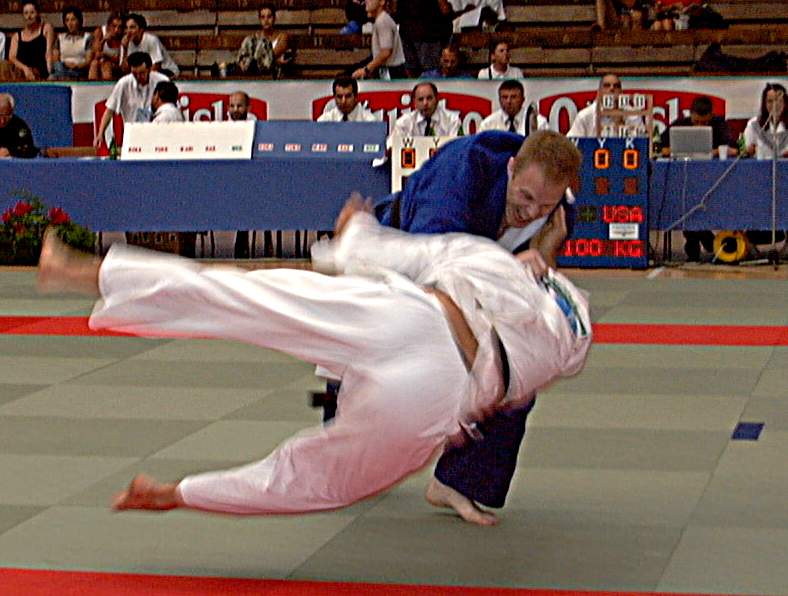
A throwing technique earns ippon when it satisfies all four criteria simultaneously, according to IJF refereeing rules:
- Speed (Kido): The throw is executed with clear momentum and quickness — not a slow, grinding takedown.
- Force (Chikara): Considerable power and efficiency are evident; the opponent is controlled, not merely tripped.
- Back (Ushiro): The opponent lands predominantly on their back, with shoulders at a minimum 90° angle to the tatami. Landing on the side, stomach, or quarter-turn does not qualify.
- Control (Shizai): The throwing judoka maintains skilful control through the entire arc of the throw, including the landing. Releasing control mid-throw downgrades the score.
If any one of these four elements is absent or clearly deficient, the referee awards a waza-ari (half point) instead. This four-criteria framework is why elite judo is as much about completing a throw cleanly as initiating it — a sloppy finish to an otherwise powerful throw scores less.
Osaekomi ippon: the 20-second rule
When an athlete holds their opponent on their back in a controlling pin (osaekomi), the referee calls “Osaekomi!” and a mat-side clock begins. If the pin is maintained continuously for 20 seconds, the referee calls “Ippon!” and the match ends. A hold broken before 20 seconds results in a partial score based on duration:
| Hold Duration | Score Awarded |
|---|---|
| 20 seconds or more | Ippon (match ends) |
| 10–19 seconds | Waza-ari |
| Under 10 seconds | No score |
The hold must involve the controlling judoka being above or to the side of the opponent — not caught between the opponent’s legs. The opponent can escape the hold by rolling, bridging, or using leg entanglement, which immediately stops the clock. In ground fighting (ne-waza), osaekomi transitions are often applied immediately after a throw, compounding pressure on the losing judoka.
Shime-waza and kansetsu-waza: submission scoring
Judo permits two categories of submission technique in competition. Shime-waza (choke techniques) apply pressure to the carotid arteries on the sides of the neck, the windpipe, or the larynx, reducing blood flow or airway until the opponent taps out or the referee stops the match due to incapacitation. Kansetsu-waza (joint locks) are restricted under IJF rules to the elbow joint — shoulder, wrist, and knee locks are prohibited in senior competition. Armlock ippon is awarded when the opponent taps (slaps the mat or their own body twice), verbally submits, or is rendered unable to continue. The referee calls the hold immediately on a tap and awards ippon. Importantly, these techniques are only permitted in ne-waza (ground fighting) — attempting a choke or armlock while standing constitutes an infraction.
Hansoku-make: ippon awarded by disqualification
A judoka can receive ippon not by executing a technique but by accumulating sufficient penalties against their opponent. Under the current IJF system, three shido (minor penalty) warnings against one athlete result in hansoku-make — direct disqualification — which awards ippon to their opponent. A single egregious infraction (such as a dangerous technique, intentional injury, or serious misconduct) also triggers immediate hansoku-make, regardless of prior shido count. Penalty-driven ippon has become more common in the current era because the IJF’s 2010 ban on leg grabs and subsequent rule tightening made defensive judo riskier; athletes who stall or grip illegally accumulate shidos faster than earlier generations.
Ippon vs Waza-ari: How the Modern Judo Scoring System Works
Modern competitive judo uses exactly two scores: ippon and waza-ari. This two-tier system replaced a four-level structure that had included yuko and koka, and its simplicity is intentional. Referees now make binary judgments — either a technique meets the ippon standard, falls into waza-ari territory, or scores nothing. Understanding this system and how waza-ari accumulates toward ippon explains a significant portion of match strategy at every level of competition, from club tournaments to the IJF World Tour.
The 2017 IJF reform that eliminated yuko and koka
Until 2017, IJF rules recognised four scoring levels: ippon (full point), waza-ari (half point), yuko (minor score, roughly a quarter point), and koka (small advantage, essentially a marginal score). Yuko and koka were eliminated because they encouraged defensive, grinding judo — athletes could win on accumulated minor scores without ever attempting anything decisive. The reform forced competitors to go for waza-ari and ippon, producing more attacking, watchable matches. The current system means any score below waza-ari registers as nothing, raising the technical bar for every scoring attempt.
What separates a throwing ippon from a waza-ari
The distinction is the completeness of the four criteria. A throw that has speed, force, and control but lands the opponent on their side rather than their back scores waza-ari. A throw that places the opponent directly on their back but was executed with insufficient speed scores waza-ari. Referees use slow-motion review (at elite events) and instantaneous judgment to classify each throw. In practice, the back-landing criterion is the most commonly contested — Wikipedia’s judo rules overview notes that shoulders must reach at least 90° to the mat for ippon. A judoka thrown to 45° lands on their side and earns their opponent only waza-ari, not ippon — the match continues.
Waza-ari awasete ippon: two half-points combine into a win
If a judoka scores two waza-ari in a single match, those scores combine into waza-ari awasete ippon — the equivalent of a full ippon — and the match ends immediately. The second waza-ari functions as the match-ending score; the referee simultaneously calls the score and the end of the contest. This rule creates a significant strategic dimension: a judoka trailing by one waza-ari knows their opponent is one clean throw away from victory, even if the opponent’s last effort was not ippon-quality. It also encourages continued attacking rather than defensive consolidation after scoring once.
The most striking fact about ippon is also the most counterintuitive: at elite level, attempting an ippon-quality technique — with maximum commitment — succeeds more often than caution. Tokyo 2020 data showed 65.4% of matches ended by ippon, meaning elite judoka — the athletes best positioned to defend against decisive attacks — are still being caught and thrown cleanly at that rate. If you want to understand judo more deeply, watch a single match with this scoring framework in mind: track every exchange for which of the four ippon criteria it meets, and you will see the sport’s technical vocabulary come alive.
Frequently Asked Questions
What is the difference between ippon and waza-ari in judo?
Ippon is a full score that ends the match immediately; waza-ari is a half score that does not end the match. A throw earns waza-ari when it meets some but not all four ippon criteria (typically lacking full back landing or sufficient speed). Two waza-ari equal an ippon and also end the match.
How long do you have to pin someone to score ippon in judo?
A continuous pin (osaekomi) held for 20 seconds earns ippon and ends the match. Holding for 10–19 seconds scores a waza-ari. Any hold broken before 10 seconds awards no score.
Can you score ippon by submission in judo?
Yes. A submission via choke (shime-waza) or elbow joint lock (kansetsu-waza) that causes the opponent to tap out, verbally submit, or become incapacitated earns ippon immediately. These techniques are only permitted in ground fighting (ne-waza) at the senior competition level.
What was yuko in judo, and why was it eliminated?
Yuko was a scoring level below waza-ari, awarded for throws that partially met ippon criteria. It was eliminated by the IJF in 2017 along with the even lesser koka score, because both encouraged defensive, low-risk judo. The current two-score system (ippon and waza-ari only) forces competitors to attempt more decisive techniques.
What happens after ippon is scored?
The referee calls “Ippon!” and raises one hand fully overhead. The match ends immediately. Both athletes return to their starting lines and bow. The match result is recorded and the winning athlete advances in the tournament bracket or earns their competition points.