Every judo match can end in two ways without a direct ippon: one decisive throw that satisfies all four scoring criteria, or two partial scores that add up to the same result. That second path — two waza-ari combining to end the contest — is called waza-ari awasete ippon, and it is one of the most tactically significant rules in competitive judo. Understanding how two waza-ari equal ippon, what separates a waza-ari from a full ippon, and how this rule has shifted over the past decade clarifies everything from referee decisions to athlete game plans at the IJF World Tour level.
- A waza-ari is awarded when a throw lands the opponent on their side or lower back — not fully flat — or when a groundwork pin lasts 10–19 seconds.
- Two waza-ari combine to end the match exactly like a direct ippon, announced by the referee as “waza-ari, awasete ippon.”
- Waza-ari is the only cumulative score in judo — yuko points do not accumulate toward ippon.
- The IJF briefly removed the accumulation rule in 2017; after one year of criticism it was reinstated in 2018.
- Under 2025 rules, yuko returned as the smallest score, but it never combines toward ippon — only waza-ari does.
What Counts as a Waza-Ari — and How It Differs from Ippon
A waza-ari sits one step below ippon in judo’s scoring hierarchy, awarded when a technique is largely correct but falls short of the highest standard. Under IJF refereeing rules, an ippon requires all four elements simultaneously: the opponent must land flat on their back, with force, with speed, and under the thrower’s skillful control through the end of the landing. A waza-ari is recorded when at least one of those four criteria is missing — the throw has genuine quality, but something is incomplete. The most common scenarios are landing on the opponent’s side or lower back instead of fully flat, or a technique with good control but lacking the explosive power characteristic of a full ippon. Because the boundary is a matter of degree rather than kind, waza-ari decisions require careful judgment from the referee and the two table officials who jointly form the evaluation panel.
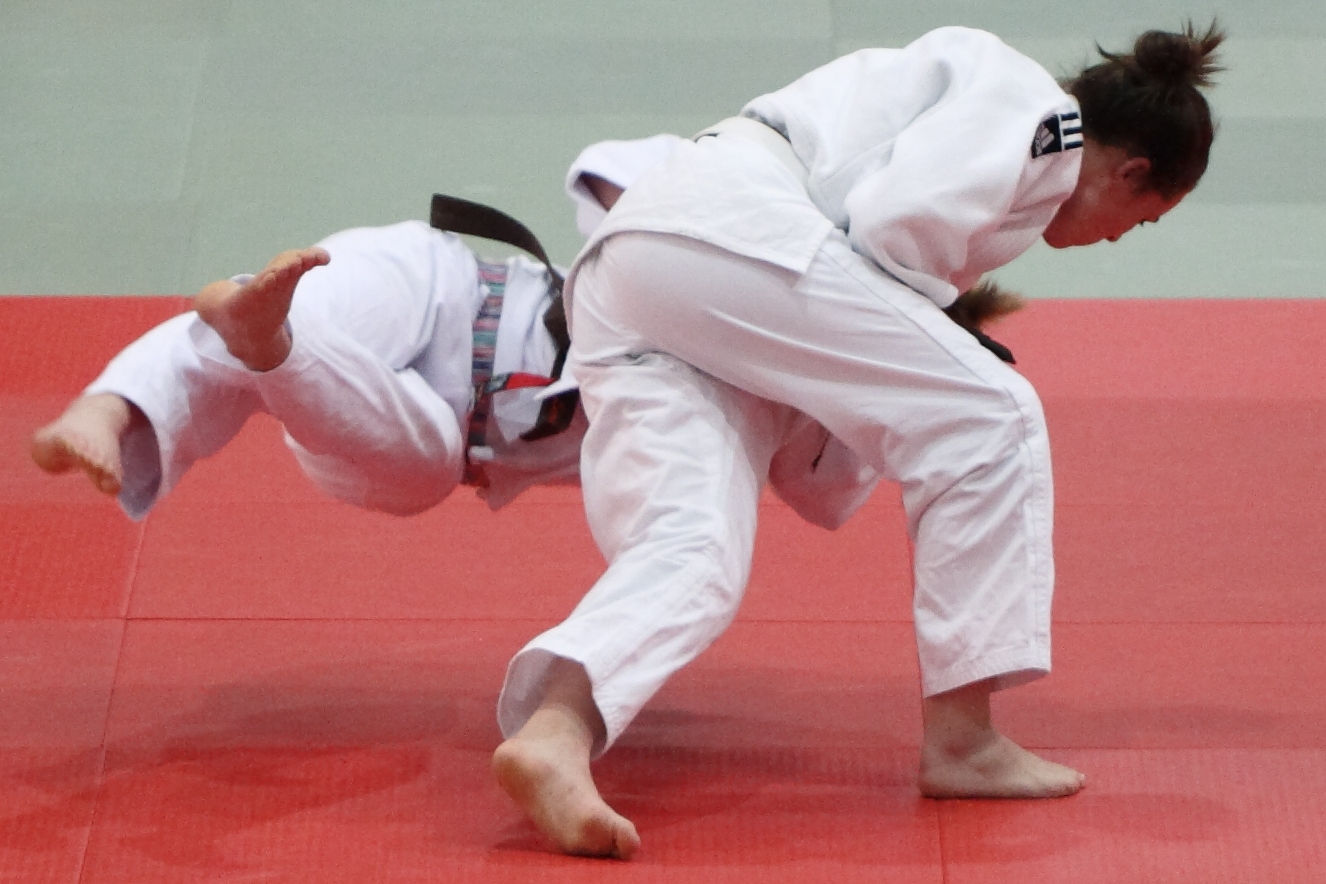

The four criteria that separate ippon from waza-ari
Judo scoring uses a four-part test for ippon: speed (ikioi), force, the opponent landing on their back, and the thrower maintaining control until the moment of impact. According to the official IJF refereeing guidelines, all four must be present for an ippon call. When a throw satisfies three of the four — a fast, powerful technique where the opponent rolls slightly to the side rather than landing flat — the result is a waza-ari. The partial quality of the landing is the most common distinguishing factor in competition. Throws that meet only two of the criteria, or that show limited speed and power even with a near-flat landing, may attract no score at all if the referees judge the technique below the waza-ari threshold.
Waza-ari in groundwork: the osaekomi time window
Waza-ari is not limited to standing techniques. In ne-waza (groundwork), a pin — officially an osaekomi-waza — also generates scores based on duration. According to NBC Olympics’ Paris 2024 rules guide, a pin held for 20 or more seconds earns a direct ippon; holding for 10 to 19 seconds earns a waza-ari. Under the 2025 IJF rule revision, a yuko — the newly reinstated smallest score — is awarded for a hold lasting 5 to 9 seconds. The practical consequence is that two separate 10-second pins in groundwork, each earning a waza-ari, combine to end the match by waza-ari awasete ippon even without a single standing throw landing cleanly. This is particularly relevant in heavier weight categories where groundwork battles play a larger role.
Why waza-ari is the only score that accumulates
Among all scores in judo, waza-ari is uniquely cumulative. A single waza-ari counts as half an ippon, and a second one completes the equation. Yuko, which Wikipedia’s judo rules article notes was reinstated for the 2025 cycle after being removed in 2017, does not stack toward ippon regardless of how many a competitor accumulates. Multiple yuko scores matter only as a tiebreaker if both athletes finish regulation time without a waza-ari — in that scenario the athlete with more yuko wins. But no quantity of yuko can substitute for a waza-ari. The scoring hierarchy is strict: ippon ends the match outright, two waza-ari end it via accumulation, and yuko settles only a penalty-free draw.
How the Match Ends: The Waza-Ari Awasete Ippon Rule
When a competitor scores their second waza-ari, the match ends immediately — there is no continuation. The referee delivers a two-part gesture: the arm is first raised laterally, parallel to the ground, to signal the second waza-ari (the same gesture used for any waza-ari call), and then the arm continues rising vertically to the full ippon position. Simultaneously, the referee announces “Waza-ari, awasete ippon” — loosely translated as “waza-ari, together making ippon” — before calling sore made to formally end the contest. The combined gesture communicates to scorers, athletes, and spectators that the cumulative total has reached the match-winning threshold, even though neither individual score was a direct ippon.
The referee signal and “waza-ari awasete ippon” call
The referee’s movement for waza-ari awasete ippon is a fluid continuation of two standard gestures. For any single waza-ari, the arm extends sideways at shoulder height. When that same action results in a second waza-ari, the arm sweeps upward in one motion through the waza-ari position and finishes pointing straight up — the universal ippon signal. According to the US Judo Federation’s referee gestures guide, this continuous upward arc distinguishes waza-ari awasete ippon from a standalone ippon call, giving competitors a visual cue even before the verbal announcement. The phrase itself is Japanese: awasete means “together” or “combined,” marking that this result is earned cumulatively rather than in a single decisive action.
Strategic implications of the accumulation rule
The two-waza-ari rule directly shapes how elite judoka plan a match. A competitor who scores the first waza-ari enters what practitioners call a “one throw wins” scenario: one more clean partial score closes the contest. Their opponent, down by a waza-ari with regulation time ticking, is forced to take offensive risk rather than stall — a waza-ari deficit cannot be erased by penalties or yuko; it requires a matching waza-ari or an outright ippon to level the contest. Coaches at the IJF Grand Slam level specifically design grip strategies and transition attacks around protecting an early waza-ari lead, since the accumulation rule makes even a partial throw score strategically decisive in a way that a yuko advantage never can be.
Waza-ari vs yuko: how both scores coexist under 2025 rules
The 2025 IJF rule update reintroduced yuko as a third tier of scoring, creating a structure that had not existed since 2016. Under the current framework, yuko is awarded for a partial throw of lesser quality than waza-ari, or for a groundwork pin lasting 5 to 9 seconds. However, the IJF’s announcement of the adapted rules makes clear that ippon and two waza-ari always determine the winner outright, overriding any yuko accumulation. If one athlete has two waza-ari and the opponent has five yuko, the two-waza-ari athlete wins. Yuko serves only as a tiebreaker in matches with no waza-ari scored by either competitor — it does not interact with the two-waza-ari equals ippon mechanism.
The Rule That Was Briefly Removed — and Why It Came Back
The two-waza-ari equals ippon rule has been a cornerstone of judo scoring for decades, but it was not universally permanent. In 2017, the IJF introduced a sweeping revision that, among other changes, made waza-ari non-cumulative for the first time in the sport’s modern competitive history. For that single year, accumulating two waza-ari did not end a match; instead, a match with no ippon was decided by whoever had more waza-ari at the final whistle. The experiment was reversed. By 2018, Wikipedia’s waza-ari article records, the accumulation rule was reinstated, and waza-ari awasete ippon returned to its familiar form. The brief removal stands as one of the few times the IJF rolled back a major rule change within a single Olympic cycle.
The 2017 experiment: one year without accumulation
The 2017 rule package eliminated yuko, kept only ippon and waza-ari, and stripped waza-ari of its cumulative character. The stated rationale was to push athletes toward decisive, high-risk technique by removing the match-winning incentive of accumulating two partial scores. In practice, coaches and analysts reported the opposite effect: without the risk of waza-ari awasete ippon, athletes in a waza-ari lead had less incentive to continue attacking. Critics noted that the change inadvertently encouraged conservative play. The IJF’s 2018 reversal restored the two-waza-ari rule without reinstating yuko — reflecting a conclusion that the accumulation mechanic served its intended purpose while the minor-score tier did not. Yuko would remain absent until the 2025 cycle update.
Judo scoring evolution: from koka to yuko to 2025
The current scoring framework is the product of roughly five decades of revision. Koka — judo’s lowest historical score — was introduced in 1975 and removed from IJF competition at the end of 2008, leaving three levels: ippon, waza-ari, and yuko. Yuko itself was then removed in 2017 along with the brief non-cumulative waza-ari experiment. The 2018 update stabilized scoring at two levels — ippon and cumulative waza-ari — a format that remained unchanged through the Tokyo 2020 and Paris 2024 Olympics. The 2025 rule cycle added yuko back as a minor score and introduced it in ne-waza at the 5-second hold mark, while explicitly preserving the supremacy of ippon and waza-ari awasete ippon over any number of yuko points.
| Era | Active scores | Waza-ari accumulates? |
|---|---|---|
| Before 2009 | Ippon, Waza-ari, Yuko, Koka | Yes |
| 2009–2016 | Ippon, Waza-ari, Yuko | Yes |
| 2017 (one year) | Ippon, Waza-ari | No |
| 2018–2024 | Ippon, Waza-ari | Yes |
| 2025–present | Ippon, Waza-ari, Yuko | Yes (yuko does not) |
The least-noticed surprise in this history is how short the non-accumulative period actually was. Judo had the rule removed for a single competitive year — less than any other scoring change in the sport’s modern era — before reverting. Next time you watch a match and the referee’s arm sweeps upward from horizontal to vertical, that gesture carries the weight of a century-long tradition: two partial efforts, combined, equal the decisive moment.
Frequently Asked Questions
What is the difference between waza-ari and ippon in judo?
Ippon requires all four criteria — force, speed, the opponent landing flat on their back, and control — to be present simultaneously. Waza-ari is awarded when at least one of those four elements is missing, making it a partial but still quality score.
What does “waza-ari awasete ippon” mean?
“Awasete” means “combined” in Japanese. The full phrase means “waza-ari, combined [with the previous waza-ari], makes ippon” — indicating that two partial scores have accumulated to the match-winning total.
Can you score waza-ari in groundwork (ne-waza)?
Yes. Holding an opponent in a recognised pin for 10 to 19 seconds earns a waza-ari. A 20-second hold earns a direct ippon. Under 2025 rules, 5–9 seconds earns the smaller yuko score.
Was there ever a time when two waza-ari did not equal ippon?
Yes — briefly. In 2017, the IJF made waza-ari non-cumulative for one year. After widespread criticism that it encouraged defensive play, the accumulation rule was reinstated in 2018 and has remained in place since.
What happens if both judoka are tied on waza-ari at the end of regulation?
A tied match goes to golden score — sudden death overtime with no time limit. The first competitor to score any waza-ari, or whose opponent receives a shido penalty, wins the match.
Do yuko points combine toward ippon under 2025 rules?
No. Under 2025 IJF rules, yuko scores never combine toward ippon. They serve only as a tiebreaker in matches where neither competitor has scored a waza-ari or received a shido penalty.